Exercises
Small Workout, Big Impact: Exercises That Make Every Minute Count
Finding an open hour every single day to dedicate to the gym is an unrealistic standard for most busy adults. Between work obligations, family commitments, and everyday errands, structured physical fitness is often the first thing pushed off the schedule. A common misconception in fitness culture is that if you cannot work out for forty-five to sixty minutes, you might as well not bother at all.
Exercise physiology tells a completely different story. The human body does not track time spent inside a gym facility; it responds to mechanical tension, metabolic stress, and cardiovascular demand. When you structure your sessions around high-density movements that recruit multiple major muscle groups simultaneously, you can stimulate muscle hypertrophy, elevate your metabolic rate, and improve cardiovascular health in as little as fifteen to twenty minutes. The key is knowing which movements yield the highest return on investment and how to organize them for maximum efficiency.
The Science of High-Efficiency Training
To get substantial results out of short training bouts, you must manipulate workout density and movement selection. Workout density refers to the total volume of work performed per unit of time. By shortening rest intervals and utilizing compound movements, you place higher demands on your heart, lungs, and neuromuscular system in a fraction of the time required by traditional split routines.
Compound exercises involve multi-joint patterns that recruit prime movers, secondary assisting muscles, and stabilizing structures simultaneously. An isolated exercise like a bicep curl targets a relatively small muscle group, burning minimal calories and generating limited systemic fatigue. A compound exercise like a deadlift, squat, or push-up demands energy from dozens of muscles at once, triggering an intense systemic response, a greater post-exercise oxygen consumption effect, and a stronger stimulus for functional strength.
Foundational Movements for Maximum Output
If your goal is to extract maximum value from every single minute of exercise, the following foundational movements provide the most comprehensive physical benefits.
The Goblet Squat
Squatting is a fundamental human movement pattern that targets the quadriceps, hamstrings, gluteal complex, and calves. Holding a weight at chest height in a goblet position forces the upper back, core, and anterior stabilizers to work continuously to keep the torso upright.
-
Stand with your feet slightly wider than shoulder-width apart and your toes angled outward.
-
Hold a single dumbbell or kettlebell against your chest with both hands directly under the weight.
-
Initiate the movement by sending your hips back and bending your knees, keeping your chest proud.
-
Lower your hips until your thighs are at least parallel to the floor, ensuring your knees track directly in line with your toes.
-
Drive forcefully through your entire foot to return to the starting position, squeezing your glutes at the top.
The Push-Up with Controlled Tempo
The push-up is one of the most effective upper-body pressing movements available, requiring zero equipment while building strength in the chest, anterior deltoids, triceps, and the deep core. When performed with a controlled tempo, such as three seconds down and one second up, push-ups create intense muscular tension.
-
Begin in a high plank position with your hands placed slightly wider than shoulder-width apart.
-
Engage your abdominal muscles, glutes, and quadriceps to keep your body in a rigid, straight line from your head to your heels.
-
Lower your chest down toward the floor slowly by breaking at the elbows, keeping them tucked at roughly a forty-five-degree angle relative to your torso.
-
Stop when your chest hovers an inch above the floor, then press through your palms to return to full lockout.
The Kettlebell Swing
The kettlebell swing is an explosive hip-hinge exercise that develops the entire posterior chain, specifically targeting the glutes, hamstrings, lower back, and core, while rapidly elevating the heart rate into high-intensity cardiovascular zones.
-
Stand over a kettlebell with your feet shoulder-width apart, knees soft, and hips pushed back.
-
Grip the handle firmly with both hands, tilt the bell back toward you, and hike it backward between your legs.
-
Snap your hips forward explosively by contracting your glutes and hamstrings, driving the kettlebell up to roughly chest height.
-
Allow the weight to fall naturally back along the arc, hinging at the hips just as your forearms make contact with your inner thighs.
The Renegade Row
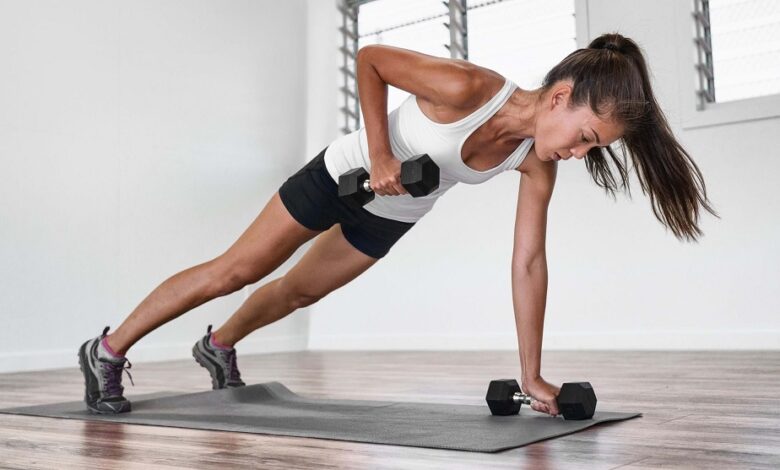
The renegade row combines a horizontal pull with an anti-rotational core hold. It builds a strong upper back, rear deltoids, and lats, while forcing the transverse abdominis and obliques to resist torso rotation under load.
-
Set up in a standard push-up position with each hand gripping the handle of a stable dumbbell placed flat on the floor.
-
Widen your foot stance slightly to provide a stable base of support.
-
Keeping your hips perfectly level, row one dumbbell up toward your ribcage, pulling your elbow back past your torso.
-
Lower the dumbbell under control to the floor, stabilize your center of gravity, and repeat the movement on the opposite side.
Structuring Short Workouts for Tangible Results
Selecting the right exercises is only half the equation. The framework you use to organize them determines the metabolic and muscular outcome of the session. Two of the most effective protocols for time-crunched individuals are density circuits and alternating antagonist pairings.
The Density Circuit Protocol
A density circuit involves choosing three or four non-competing movements and cycling through them for a set duration, such as twelve to fifteen minutes. You aim to complete as many clean, technical rounds as possible within that timeframe, resting only as much as necessary to maintain strict exercise form.
-
Ten Goblet Squats
-
Ten Push-Ups
-
Fifteen Kettlebell Swings
-
Ten Total Renegade Rows
Because each exercise targets a different physiological area, one muscle group recovers while another works, keeping your heart rate elevated and maximizing systemic output without excessive localized muscular failure.
Antagonist Supersets
Antagonist supersets pair two opposing movement patterns back to back with minimal downtime. For example, pairing an upper-body push with an upper-body pull, or a lower-body knee-dominant exercise with a lower-body hip-dominant exercise. This allows you to cut your total workout time in half while maintaining high mechanical load on each individual muscle group.
Frequently Asked Questions
Can you build visible muscle with fifteen-minute workouts?
Yes, you can stimulate muscle hypertrophy in fifteen minutes provided the training intensity is sufficient. Muscle growth requires recruiting high-threshold motor units by bringing your working sets within a few repetitions of muscular fatigue. Short sessions that focus on progressive overload and high effort on compound movements provide more than enough stimulus to trigger muscle adaptation.
How many days per week should I do short-format workouts?
Because short workouts generally produce less overall central nervous system fatigue and localized muscle damage than sixty-minute sessions, they can be performed more frequently. A frequency of four to six sessions per week works well for most individuals, allowing for consistent training stimulus and easier habit formation.
Do I need to perform a separate warm-up before a quick workout?
A warm-up is always recommended to lubricate joints and elevate tissue temperature, but it does not need to take ten minutes. A targeted two-minute dynamic routine that includes bodyweight squats, arm circles, and world-greatest-stretch lunges is sufficient to prepare the neuromuscular system for high-intensity work.
Are bodyweight exercises effective enough on their own for short workouts?
Bodyweight exercises can be exceptionally effective if you utilize challenging variations and manipulate leverage, tempo, and range of motion. Movements like tempo push-ups, jump squats, single-leg Romanian deadlifts, and walking lunges place substantial demand on the muscles without needing external weights.
How do short workouts affect resting metabolic rate compared to long cardio sessions?
Short, high-intensity compound workouts have a more favorable impact on resting metabolic rate than steady-state cardio. Resistance-based compound movements create microscopic muscle breakdown that requires metabolic energy to repair over the subsequent twenty-four to forty-eight hours, whereas standard low-intensity cardio burns energy primarily during the session itself.
What should I do if an exercise in the routine causes joint pain?
Never push through joint pain. Because efficiency relies on full effort, you should immediately substitute the offending movement with a pain-free variation that targets the same functional pattern. For example, if bilateral squats irritate your knees, substitute them with reverse lunges or step-ups, which typically place less shear stress on the knee joint.